Skip to content

The discriminant ​

Notes ​

The quadratic formula tells us that the solutions to

ax2+bx+c=0

are given by

x=−b±b2−4ac2a

But the b2−4ac can cause problems. Sometimes b2−4ac<0 and so we can't find the square root (as a real number). Thus, we say that the quadratic has no real solutions.

The number

Δ=b2−4ac

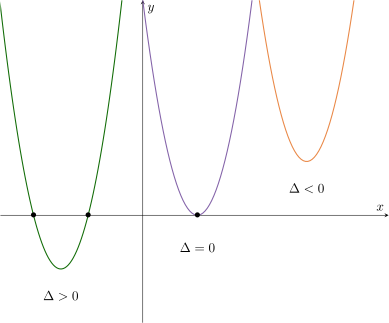
is called the discriminant and it tells us how many real roots a quadratic has.

⭐ Remember

Δ=b2−4ac is called the discriminant.

If Δ>0 then the quadratic has two distinct, real roots.

If Δ=0 then the quadratic has one real root.

If Δ<0 then the quadratic has no real roots.

parabolas with two, one or no roots

Example ​

  1. Find the number of real solutions to the equation

    x2+4x=21
  2. Find the number of real roots of the equation

    4(15x−x2)=225
  3. How many real values of n satisfy

    −5−n−n22=0
  4. Given that the equation

    kx+k−1+x2=0

    has a repeated root, find the value of k.

Exercise ​