 Mathematico
The cosine rule allows us to find missing sides or missing angles in any type of triangle.
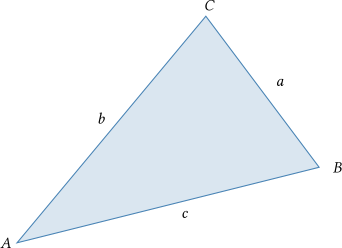
The cosine rule states that
The cosine rule starts like Pythagoras with
This would work with any of the sides at the front of the formula, so
also work.
One of the problems will invite you to try and prove the cosine rule, but for now let's get used to using it.
A triangle has sides of length
and and the angle between these sides is Find the length of the third side. 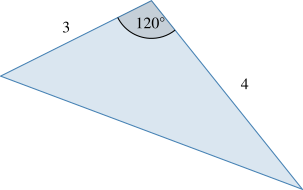
A triangle has sides of length
and and the angle between them is Given that the third side of the triangle has length find the value of 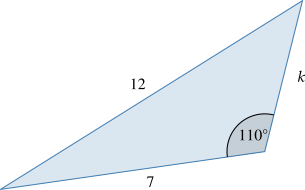
A triangle has sides of length
Find the largest angle in the triangle.